4x4 Drivetrain
Engineering.
From mechanical reduction to traction management. A definitive guide to mastering your vehicle's capability in extreme technical environments.
The Drivetrain Matrix
2-High
Standard road use. Power to rear wheels only.
Optimal Sector:
Highway / Dry Tracks
4-High
Locked center/fixed split. Traction to all 4 wheels.
Optimal Sector:
Snow / Loose Gravel
4-Low
Mechanical gear reduction. Maximum torque at low speed.
Optimal Sector:
Rock / Steep Gradient
Gear Ratio Engineering
Torque Multiplication Logic
Gear ratios are the mechanical advantage your vehicle uses to overcome terrain resistance. In 4-Low, the transfer case engages a reduction gear (typically between 2:1 and 4:1) that multiplies the torque delivered to the wheels while simultaneously dividing the vehicle's speed.
The Crawl Ratio Formula
A higher crawl ratio (e.g., 60:1) means the vehicle can "crawl" over obstacles at extremely low speeds without stalling, providing surgical control on 30%+ Himalayan gradients.
Expert Metric: Wheel Torque
Using 4L doesn't give your engine more power—it gives your wheels more force. On the "Pilu to Simikot" sectors, 4L allows the engine to stay in its power band while the wheels rotate slowly enough to maintain traction on loose shale.
Mechanical Anatomy
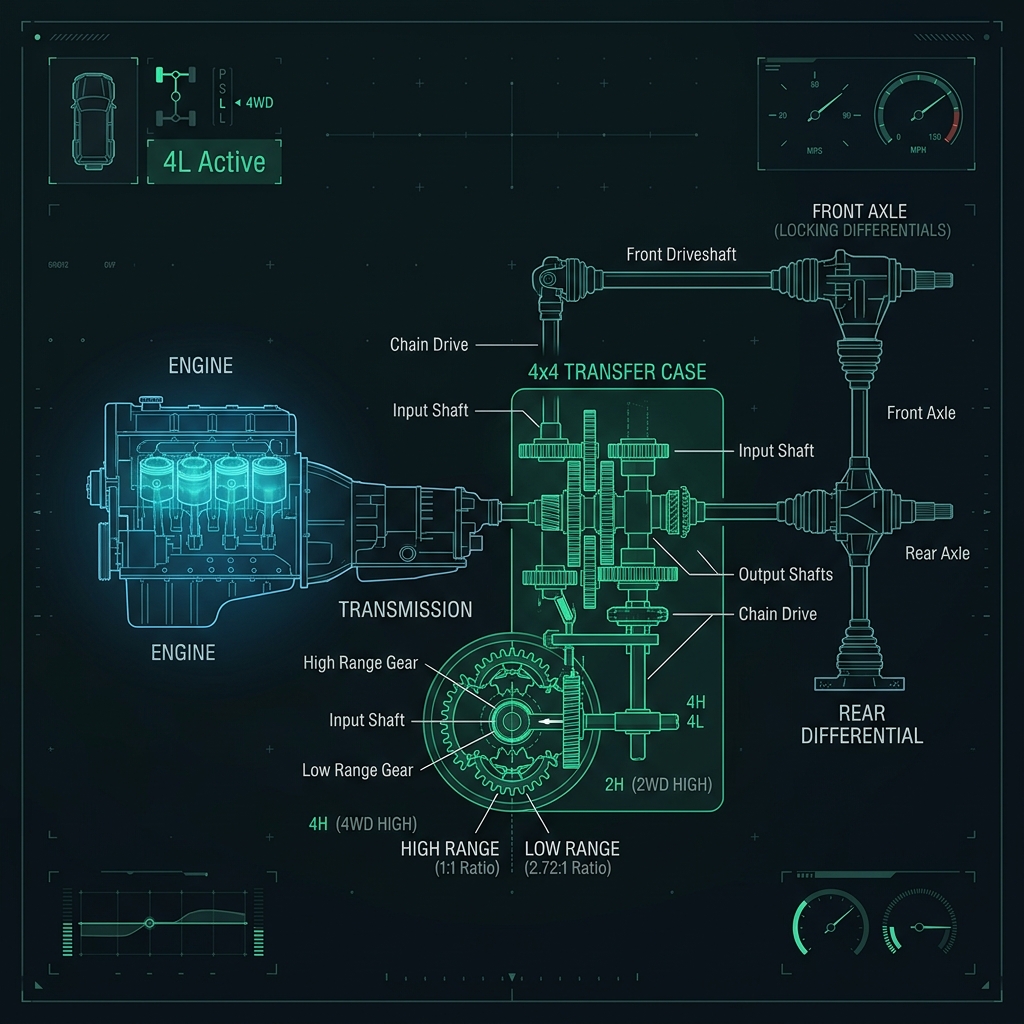
This technical schematic illustrates the torque flow from the engine through the Reduction Gearset in the transfer case. Note the mechanical transition between the High-Range (1:1) and Low-Range (2.72:1) gears, which provides the necessary torque multiplication for extreme vertical ascent.
Articulation Geometry
Wheel Travel & Flex
Maintaining a "Contact Patch" is critical. Suspension flex allows the wheels to follow the terrain's tortuosity, ensuring that even in cross-axle situations, at least three wheels retain traction.
Vertical Compliance
In high-altitude sectors with loose scree, articulation prevents the chassis from "tri-poding," which would otherwise result in immediate traction loss on the un-weighted axle.
Traction Management: Diff Locks
The Mechanical Logic
A standard (open) differential allows wheels on the same axle to rotate at different speeds—essential for cornering. However, in off-road scenarios, an open diff sends power to the wheel with the least resistance. If one wheel is in the air or on ice, it will spin while the wheel with traction remains stationary.
A Differential Lock (Locker) mechanically joins both wheels on an axle, forcing them to turn at exactly the same speed regardless of traction or ground contact.
Rear Locker Strategy
The primary tool for technical climbing. Engaging the rear locker provides consistent drive on steep gradients and loose shale. It should be your first choice for traction management as it maintains full steering control.
Front Locker Strategy
Reserved for extreme "no-momentum" situations like vertical rock ledges. A front locker forces both steering wheels to pull equally. However, it severely limits your turning radius and significantly increases drivetrain stress.
Tactical Warning: Steering Loss
With a front locker engaged, the vehicle will resist turning and tend to push straight. Only engage the front locker when traveling in a straight line or minimal steering angle is required. Disengage immediately once the obstacle is cleared to prevent CV joint failure.
Terrain Specialization
Sand Dunes
The goal is Flotation. Momentum is your primary ally. Avoid stopping on uphills or soft patches.
- Use 4-High for momentum / 4-Low for steep climbs
- Avoid sharp turns at speed (Risk of de-beading)
Snow & Ice
Focus on Smooth Inputs. High torque at low RPM is essential to prevent wheel spin on frozen surfaces.
- Engine brake in 4-Low for descents
- Avoid locked differentials on ice (steering loss)
Mud & Slop
Maintain Tread Clearing speed. Saw the steering wheel left/right to find lateral traction in ruts.
- Use 4-Low / 2nd or 3rd gear for wheel speed
- Engage Diff Lockers *before* entering mud
River Crossing
Execute the Bow Wave technique. Maintain a steady speed to create a pocket of air behind the wave.
- Scout depth on foot first (if safe)
- Never shift gears while submerged